A month later, Denver police are still looking for suspects who killed a refugee family – They need to be brought to justice!

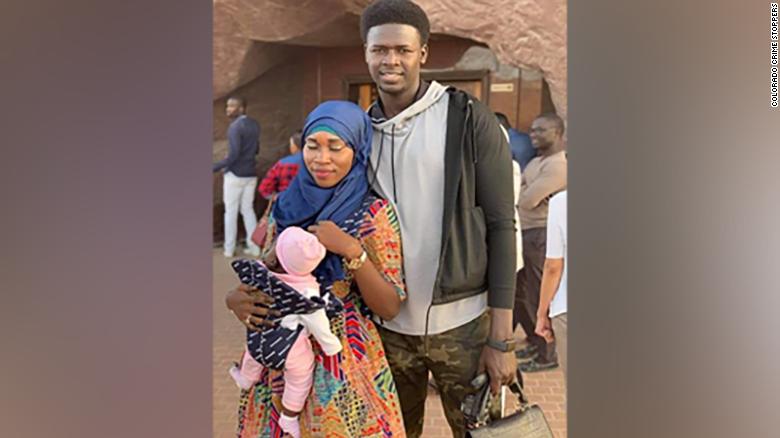
It’s been one month since a fire in Denver, Colo., took the lives of Djibril Diol, Adja Diol and their almost three-year-old daughter, Khadija, which authorities said was caused by arson. Hassan Diol and her infant daughter, Hawa Beye, died in the fire as well.

Here is a photo of Djibril and Adja Diol and their daughter:

Police in Denver released these photos of three suspects clad in white masks who they believe set the fire:

There is no doubt in my mind that the perpetrators of this horrific crime targeted the family because they were refugees.

Metro Denver Crime Stoppers (https://www.metrodenvercrimestoppers.com/) is offering a reward of $14,000 for information on the fire.

Refugee families face unique struggles with online school

Samuel Lavi, a refugee from the Congo, has come up with innovative approaches to helping refugee families cope with navigating today’s challenging educational waters due to COVID-19, reports the Associated Press.

With remote classes now underway at the K-8 school for refugee children in Phoenix, Lavi helps students connect from home with loaned iPads so they can learn English before transferring to mainstream schools, the AP noted.

Lavi “created group chats on the WhatsApp messaging app in Swahili and some of the other six languages he knows. To ensure parents who can’t read or write could participate, Lavi taught them to record and share small audio clips.”

Migration Policy Institute report offers comprehensive catalog of immigration changes by Trump administration

In a report released in July, the Migration Policy Institute offers a comprehensive catalog, by topic, of changes made by the Trump administration to the U.S. immigration system since entering office in January 2017.

The report, “Dismantling and Reconstructing the U.S. Immigration System: A Catalog of Changes under the Trump Presidency,” was written by Sarah Pierce, a Policy Analyst for the U.S. Immigration Policy Program at MPI, and Jessica Bolter, an Associate Policy Analyst with the U.S. Immigration Policy Program at MPI.

The report is available here.

Refugee families in Iowa homeless after derecho

Local news station KCCI of Des Moines, Iowa, reports that hundreds of refugee families in eastern Iowa are homeless after a recent derecho.

“Cedar Rapids remains one of the worst-damaged Iowa cities in need of recovery. It’s a need felt especially by refugees and immigrant families,” writes KCCI’s Kayla James in a story posted online.

Local resident Nancy Mwirotsi is leading an effort to help the refugees. Mwirotsi and several others “have made continuous trips from Des Moines to Cedar Rapids. They’ve brought food, clothing and any other supplies they could get,” James reported.

To donate to Mwirotsi’s effort, click here.

Biden expected to use executive powers to reverse Trump actions on immigration, refugees

If Joe Biden wins the presidency in November, he is expected to use executive powers to reverse President Trump’s changes related to immigration and refugee policy “and even end some immigration enforcement measures that have been in place for decades,” reports Michelle Hackman in a recent Wall Street Journal article.

“Many of Mr. Biden’s policy plans would require legislation to enact—but immigration is an issue where the former vice president would have the ability to enact much of Democrats’ desired agenda through regulatory changes and other executive actions,” Hackman notes in the story.

Biden has “also said he would pursue a bill providing a pathway to citizenship for the 11 million immigrants in the country who lack permanent legal status, a task made easier if Democrats take back control of the Senate.”

Also, Biden would restore the annual cap on refugees to 125,000 people “from a record-low 18,000, and end a program that sends asylum seekers back across the border to Mexico to await their immigration hearings.”

N.Y. Times article details link to climate change and migration patterns

Migration researchers have found “climate’s subtle fingerprints almost everywhere,” writes Abrahm Lustgarten in a recent article for the New York Times Magazine.

“As the mechanisms of climate migration have come into sharper focus — food scarcity, water scarcity and heat — the latent potential for large-scale movement comes to seem astronomically larger,” writes Lustgarten.

The New York Times Magazine and ProPublica joined with the Pulitzer Center in an effort to model, for the first time, how people will move across borders.

While the model is not definitive, “every one of the scenarios it produces points to a future in which climate change, currently a subtle disrupting influence, becomes a source of major disruption, increasingly driving the displacement of vast populations,” Lustgarten reported.

A worst-case scenario could be “one in which America and the rest of the developed world refuse to welcome migrants but also fail to help them at home. As our model demonstrated, closing borders while stinting on development creates a somewhat counterintuitive population surge even as temperatures rise, trapping more and more people in places that are increasingly unsuited to human life,” writes Lustgarten.

ICE says students switching to online courses will have to leave U.S.

Immigration and Customs Enforcement (ICE) announced on Monday that international students in the U.S. whose schools switch to online classes for the fall semester “will have to leave the country or risk violating their visa status,” reports Rafael Bernal in the Hill.

The agency said affected students on F-1 and M-1 visas in the US “could transfer to a school offering in-person classes to maintain their legal status. Otherwise, they risk being put in deportation proceedings,” Buzzfeed News reported.

“As college students across the United States and around the world contemplate what their upcoming semester might look like, the federal guidance limits options for international students and leaves them with an uncomfortable choice: attend in-person classes during a pandemic or take them online from another country,” NPR reported.

“And for students enrolled in schools that have already announced plans to operate fully online, there is no choice. Under the new rules, the State Department will not issue them visas, and U.S. Customs and Border Protection will not allow them to enter the country,” NPR noted.

Biden unveils plan to increase cap on refugees allowed into the U.S.

Joe Biden, the presumptive presidential nominee for the Democratic Party, on World Refugee Day (June 20) said that as President he would increase the number of refugees the U.S. welcomes into the country, setting an annual global refugee target of 125,000 — up from a ceiling of 18,000 under President Trump — “and will seek to further raise it over time commensurate with our responsibility, our values, and the unprecedented global need.”

Biden outlined his plans in a statement posted on Medium.

Biden said that he will support efforts to work with Congress in a bipartisan fashion “to protect our refugee policy from drastic and arbitrary reductions we have seen during the Trump Administration and establish a minimum admissions number of at least 95,000 refugees annually.”

He will also pursue policies that increase opportunities for faith and local communities to sponsor refugee resettlement. “I will make more channels, such as higher education visas, available to those seeking safety. I will repeal the Muslim ban — and other discriminatory bans based on ethnicity and nationality — and restore asylum laws, including ending the horrific practice of separating families at our border,” he wrote.

Jill Biden pens Op-Ed on refugees

Meanwhile, Jill Biden noted in a June 22 Op-Ed that as Second Lady, and in her work after as well, she has traveled to refugee camps around the world.

“From Kenya to Jordan to Greece to Ethiopia to the Matamoros Tent Camp on the U.S. border, I have seen the truth of Warsan Shire’s poetry, that ‘no one leaves home unless home is the mouth of a shark,'” Biden wrote.

Supreme Court hands Trump defeat on DACA

The Supreme Court ruled Thursday that the Trump administration may not immediately proceed with its plan to end a program protecting about 700,000 young immigrants known as Dreamers from deportation, “dealing a surprising setback to one of President Trump’s central campaign promises,” the New York Times reported.

The ruling delivered “a hard-won victory to hundreds of thousands of young immigrants who have been living in limbo since President Donald Trump tried to dismantle the program, wrote Nicole Narea in a story for Vox.

The decision marked “the second stunning election-season rebuke from the court in a week after its ruling that it’s illegal to fire people because they’re gay or transgender,” wrote Mark Sherman for the Associated Press.

“The 5-4 outcome, in which Chief Justice John Roberts and the four liberal justices were in the majority, seems certain to elevate the issue in Trump’s campaign, given the anti-immigrant rhetoric of his first presidential run in 2016 and immigration restrictions his administration has imposed since then,” Sherman reported.

Trump considers another attempt to cancel program

The Trump administration “signaled that it was considering another attempt to cancel an Obama-era program that provided legal protections and work permits to unauthorized immigrants who came to the U.S. as children, a day after a loss at the Supreme Court injected the issue into an already contentious election cycle,” The Wall Street Journal reported on June 19.

Global forced displacement vastly more widespread in 2019

One per cent of the world’s population has been forced to flee their homes due to war, conflict and persecution to seek safety either somewhere within their country or in another country, according to the latest Global Trends report released June 18 by UNHCR, the UN Refugee Agency.

At the end of 2019, there were 79.5 million people around the world who had been forcibly displaced, according to the yearly report, up from 70.8 million the year before. The rise was in part due to worrying new displacement in places such as the Democratic Republic of the Congo, the Sahel region of Africa, Yemen and Syria. It also reflected the inclusion for the first time of 3.6 million Venezuelans who have been displaced outside their country but who have not sought asylum.